Many celebrities are rumored to have had cosmetic surgery. Very few ever confirm it publicly.
Even fewer share photographs taken immediately after surgery while still wearing postoperative dressings. In fact, there is one celebrity who did exactly that—posting his recovery journey online with remarkable honesty and a sense of humor.
Today’s celebrity facelift case study features:
Marc Jacobs.
Marc Jacobs is an American fashion designer.
Born in New York City in 1963, he graduated from the prestigious Parsons School of Design and quickly emerged as one of the most influential young designers of his generation.
In the 1990s, he became particularly well known for bringing the grunge aesthetic to the runway, blending high fashion with street-inspired style in a way that challenged industry conventions.
Later, from 1997 to 2014, he served as the Creative Director of Louis Vuitton, where he played a pivotal role in introducing modern ready-to-wear fashion into one of the world’s most iconic luxury brands. His influence on contemporary fashion continues to be felt today.
During his tenure, Louis Vuitton evolved from a company best known for its heritage luggage into one of the most influential and fashion-forward luxury houses in the world. At the same time, he continued to build and expand his own eponymous label, Marc Jacobs, which remains an active and influential brand today. Then, in 2021, he publicly revealed that he had undergone a deep plane facelift. What made the announcement particularly remarkable was not just the surgery itself, but the way he chose to share it.
And that, in my opinion, was truly fascinating.
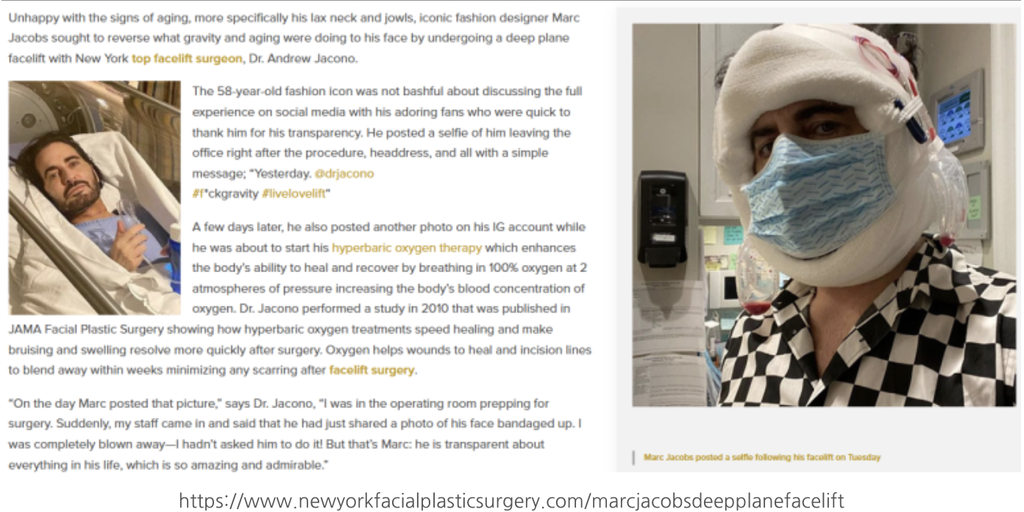
The day after surgery, he posted a simple selfie of himself with his face wrapped in bandages.
“Yesterday.”
@drjacono
#f*ckgravity #livelovelift
What struck me most was the contrast.
Here was one of the most stylish figures in the fashion world, willingly sharing himself at perhaps his least glamorous moment—and doing so with humor and confidence.
I think that image tells a story all by itself. The procedure he underwent was a Deep Plane Facelift. And the surgeon who performed it was Dr. Andrew Jacono, one of the physicians most closely associated with popularizing this facelift technique in the United States.
Today, he is widely regarded as one of the leading authorities on the Deep Plane Facelift. (Perhaps I’ll dedicate a future post to Dr. Jacono and his surgical philosophy, as his work has had a significant influence on modern facial rejuvenation surgery.) Like Marc Jacobs, many celebrities and public figures have entrusted their facial rejuvenation procedures to Dr. Jacono, and some of these cases have even been shared publicly through social media.
Following surgery, Marc Jacobs also underwent hyperbaric oxygen therapy (HBOT) as part of his recovery process.
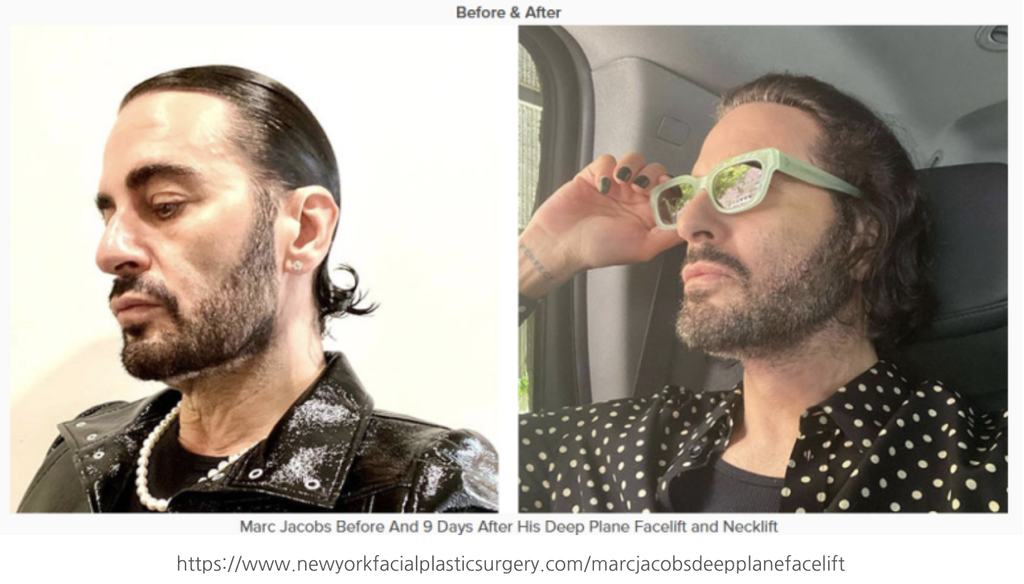
This treatment involves breathing 100% oxygen in a pressurized chamber, allowing a higher concentration of oxygen to be delivered to healing tissues. The goal is to support recovery by reducing swelling and bruising while promoting tissue healing. The results can be appreciated in the photographs below.

Just four days after surgery, the recovery appears impressive. There is minimal visible bruising, very little swelling, and the facial contours already look remarkably clean and defined. Looking at these images, one could easily forget that this was the result of a surgical procedure performed only days before.
Throughout his career, Marc Jacobs has been someone who challenged conventions and pushed cultural boundaries through fashion. With this decision, he did something similar once again—this time by openly discussing cosmetic surgery. In many societies, aesthetic procedures are still viewed as something that should be kept private.
Facelift surgery, in particular, remains surrounded by concerns about looking “overdone” or appearing obviously surgical. (Although, judging by these photographs, the outcome seems far more natural than many people might expect.) In that sense, Marc Jacobs’ openness feels somewhat pioneering.
Yet I suspect that attitudes will continue to change. As I’ve mentioned in previous posts, I believe the day will come when having a facelift at fifty is viewed much the same way that having eyelid surgery at twenty is viewed today—simply as a personal choice and a normal part of aesthetic self-care.
Perhaps we’re not quite there yet.But I think we’re getting closer. (And yes, maybe that’s the plastic surgeon in me talking.)
Thank you for reading, and I’ll come back with a more interesting topic in the next post.