If you specialize in facelift surgery,
SMAS is a topic you inevitably have to address at least once.
In Korea, this structure is sometimes referred to as the fascia, which is why many people also call it the SMAS fascia.

(It’s the part being lifted with a hook in the image on the right.)
If you have studied facelift surgery (facelift, rhytidectomy) even a little, this is probably a term you’ve already encountered.
In fact, almost all academic lectures, surgical videos, and educational content on facelifts tend to focus on two key structures:
- SMAS (often referred to as a fascia, although strictly speaking it is not a true fascia)
- Retaining ligaments
These two concepts form the foundation of most discussions about facelift anatomy and technique. (Here, for convenience, SMAS = smas = fascia will be used interchangeably.)
After the term SMAS / smas / fascia began to gain popularity, many surgeons started to emphasize in their marketing that the ability to manipulate the SMAS is directly related to surgical skill.
In surgery, the process of separating the target structure from the surrounding tissues is called “dissection.” For example, in procedures designed to help patients open their eyes more clearly (such as ptosis correction surgery), the surgeon needs to dissect the structures corresponding to the levator muscle and its aponeurosis. (This is the kind of context in which the term is typically used.)
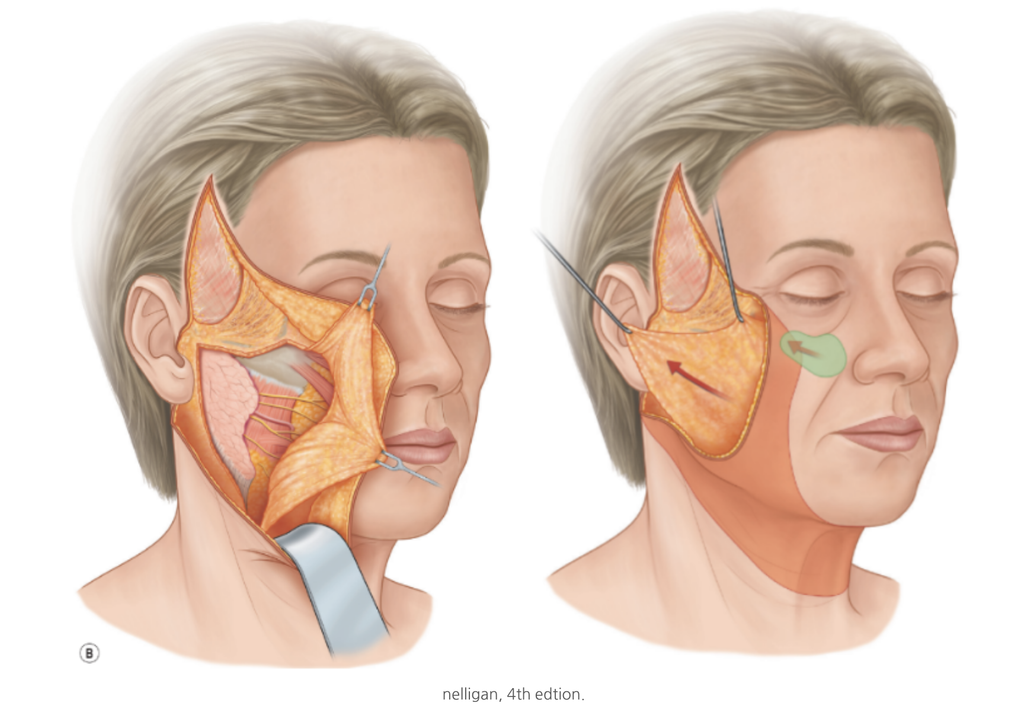
(In this context, separating a structure in order to manipulate it surgically is what we refer to as “dissection.”)
Anyway, if a surgeon can dissect the SMAS, they are considered skilled; if they cannot, they are considered less skilled.
This kind of messaging has formed the basis of marketing in many clinics.
So when I first began performing facelift surgery, my primary goal was also to develop the ability to properly dissect the SMAS layer.
At first, I focused on dissecting what is commonly called the SMAS in every facelift patient. The process itself was long and challenging…
But to summarize briefly, in the end, I did develop the technical ability to dissect the SMAS even under very difficult conditions. However, the more surgeries I performed, the more I began to notice things that didn’t match what the textbooks described.
First of all, the structure referred to as the SMAS varied greatly from person to person.
In some patients, there was a firm structure that could reasonably be called SMAS.
But in others, it felt more like a thin fatty layer— a fragile tissue that separated very easily.
And interestingly, as I moved closer to the anterior face, where we expect to see improvements in areas such as the nasolabial folds and jowls, this phenomenon became even more pronounced.
The tough, fascial-like structure gradually disappeared, leaving behind only a soft fatty layer.
Yet surgically, we are supposed to dissect a fascial plane there—so it often felt as if I was simply creating a very thin layer and calling it “SMAS” for the sake of convention.
It was as if I went into surgery expecting to find a clearly defined, tough fascial layer—like the dense connective tissue you trim away when preparing beef chuck flap, the kind that is firm and difficult to tear even when you chew it.
But in reality, what I often encountered was something closer to the white fatty layer of pork belly— without a clear boundary, and easily frayed, torn, or perforated with just a small amount of tension, more like loose fatty tissue than a distinct fascial structure.
The original concept behind SMAS (fascia)–based facelift surgery lies in taking advantage of the firm, durable properties of the SMAS layer. The idea is that once the SMAS is dissected, and then elevated and secured under tension, this strong fascial layer can support the areas we aim to improve in the anterior face—such as the nasolabial folds, deep cheek fat, and jowls—thereby helping to correct facial sagging more effectively.
But what if that strong fascial layer turns out to be thin and weak— or in some cases,
what if it’s not really there at all?

Even when I carefully dissected this thin and fragile fascial layer, and elevated and secured it with sufficient tension, there were still cases in which facial sagging recurred over the long term. (This is something I’ve mentioned before— it connects to the idea that “the face should not simply be pulled.”)
At around 6 months to 1 year after surgery, there were cases in which the results turned out to be less satisfactory than expected. Even in cases where the supposedly difficult SMAS layer had been dissected exactly as described in the textbooks—or even more cleanly than the textbook descriptions—these kinds of outcomes began to appear from time to time.
So what did I do next?
I’ll continue in the next article.